How They Differ and Which Suits You
Displacement vs Semi-Displacement Hulls
Every yacht hull starts with one question. Should she move through the water, or rise over it? The answer shapes almost everything that follows: speed, range, fuel use and how calm life on board feels in a swell.
This guide explains what a displacement hull is, what a semi-displacement hull is and how the two compare, with published figures from a 37.4m (122ft 8in) yacht. New to the subject? Our guide to the different types of boat hulls is a good place to start.
What Is a Displacement Hull?
A displacement hull moves through the water rather than on top of it. As she moves, the yacht pushes aside a volume of water equal to her own weight, which is where the name comes from. However fast she goes, the hull stays in the water.
Displacement hulls are usually deep and round-bilged, with a fine bow that lets water flow around the hull with as little resistance as possible. The result is a yacht that’s efficient and comfortable at moderate speed, over very long distances.
Key Characteristics
- Moves through the water at every speed
- Very fuel efficient at moderate speed
- Soft, predictable motion in a seaway
- Generous interior volume for her length
- Top speed set by her waterline length
Hull Speed: the Natural Limit
Every displacement hull has a natural speed limit, known as hull speed. As a yacht gathers pace she creates a bow wave and a stern wave. At hull speed, the distance between the two equals her waterline length, and she is in effect climbing her own bow wave.
A long-standing rule of thumb puts hull speed at 1.34 times the square root of the waterline length in feet. For a waterline of 35.6m (117ft), that’s about 14.5 knots. Going faster takes a sharp rise in power.
That’s why displacement hulls are the natural choice for explorer and expedition yachts, and for owners who measure a voyage in oceans rather than hours.
What Is a Semi-Displacement Hull?
A semi-displacement hull sits between a displacement hull and a planing hull. At low speed she behaves like a displacement yacht. As speed rises, flatter sections towards the stern generate lift, and the hull rises partly out of the water.
That partial lift lets her run beyond hull speed without the power a planing hull needs. She never fully planes. In practice, a semi-displacement yacht cruises efficiently at her everyday speed and still has pace in reserve.
Key Characteristics
- Runs beyond hull speed without fully planing
- Efficient at economical speed, faster when you need it
- Stable and comfortable at sea
- Suitable for ocean passages
Fast Displacement: the Refined Version
Many yards and naval architects use the term fast displacement for a semi-displacement hull that keeps much of the displacement hull’s character. Long, slender and seakindly, with just enough lift aft to run comfortably beyond hull speed. It suits ocean-going motor yachts that also want pace on coastal legs.


Displacement vs Semi-Displacement Hull: Side by Side
Both hull types are built for the open sea. The difference lies in how each one handles speed, and what that speed costs.
| Displacement hull | Semi-displacement hull | |
|---|---|---|
| How she moves | Through the water at every speed | Through the water, with partial lift at higher speed |
| Top speed | Close to hull speed | Beyond hull speed |
| Efficiency | Excellent at moderate speed | Excellent at economical speed |
| Range | Very long | Long at economical speed |
| Motion at sea | Soft and predictable | Stable, with good control at speed |
| Typical use | Explorer yachts and long ocean passages | Ocean-going motor yachts that also want pace |
How Naval Architects Classify Hulls
Naval architects describe these speed regimes with the Froude number, which relates speed to waterline length. Below roughly 0.4, a hull behaves as a displacement hull. Between about 0.4 and 1.0 it’s in the semi-displacement range, and above that it planes.
The figures make this concrete. On a 35.6m (117ft) waterline, 14.5 knots gives a Froude number of 0.40. At 17 knots it’s 0.47, just inside the semi-displacement range.

Planing vs Displacement Hull: Where Planing Fits In
A planing hull is designed to rise up and skim across the surface once she has enough speed. That brings high top speeds, but it takes a lot of power to get there. Below planing speed, the hull is at its least efficient.
- High top speed
- Suited to day trips and coastal cruising
- Least efficient at low and moderate speed
- Can pound in a head sea
For owners who plan long passages, the choice usually comes down to displacement or semi-displacement. Planing is the right answer when the destination is close and getting there quickly matters most.
Speed, Fuel and Range: What the Numbers Show
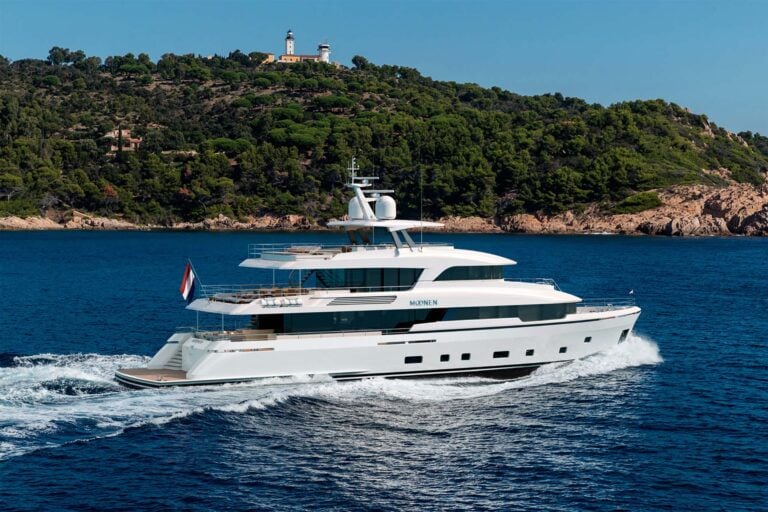
Published figures for the Moonen 122 Martinique show what this means in practice. She’s a 37.4m (122ft 8in) fast-displacement yacht with a 35.6m (117ft) waterline. Consumption is measured with both main engines plus generator power running.
| Speed | Consumption per hour | Fuel per nautical mile |
|---|---|---|
| 10 knots (economical) | 80l (21 US gallons) | 8l |
| 14.5 knots (cruising) | 335l (89 US gallons) | 23l |
| 17 knots (maximum) | 700l (185 US gallons) | 41l |
At her economical speed of 10 knots she runs in the displacement range, using 8 litres of fuel per nautical mile. Her cruising speed of 14.5 knots sits right at her calculated hull speed, the point where a pure displacement hull of her length reaches its natural limit. The Martinique keeps going, to 17 knots, because her hull is designed for it.
At 10 knots, 35,000l of fuel gives a published range of 4000 nautical miles. Enough to cross the Atlantic. Economy when you cruise. Pace when you need it. For more on what drives consumption, read what affects yacht fuel consumption at sea.
Which Hull Suits the Way You Cruise?
Start with how you plan to use the yacht, not with her top speed. For many owners, what matters most is how she feels on the third day of a passage. A hull that’s efficient and calm at her everyday speed is worth more than knots you’ll rarely use.
Long Ocean Passages
A steady pace, maximum range.
- Choose a displacement hull
- Lowest fuel use per mile
- Softest motion on long crossings
Oceans and Coastlines
Crossings, plus faster coastal legs.
- Choose a semi-displacement or fast-displacement hull
- Economy at cruising speed
- Extra pace when the weather or the schedule asks for it
Short Hops at Speed
Day trips and quick transfers.
- Choose a planing hull
- Highest top speed
- Most fuel per mile
Shallow Anchorages
Hidden bays and island hopping.
- Check draft as well as hull type
- The Moonen 122 Martinique draws 2.15m (7ft)
- Ideal for places such as the Bahamas
Pro Tip:
When you compare yachts, ask for fuel figures measured with generators running, at the speeds you’ll actually use. Figures for the main engines alone flatter every hull.
The Moonen Approach: Fast Displacement in Steel
At Moonen, hull form is where comfort and range begin. Our yachts are built to cross oceans, so every platform starts with the hull that suits her purpose.
1. Fast Displacement by Design
The Moonen 122 Martinique has a fast-displacement hull, with naval architecture by Diana Yacht Design. We optimised the hull form to reduce resistance through the water, so she consumes less fuel. Her top speed is 17 knots.
2. Steel Below, Aluminium Above
Every hull we build is in steel, and every superstructure aluminium. Steel brings strength and mass where the yacht meets the water. Aluminium keeps weight low up high, which helps stability. More on why we build in steel.
3. Range You Can Use
4000 nautical miles @ 10kn from 35,000l of fuel. Transatlantic, without a refuelling stop. The Moonen 110, a blue-water displacement cruiser, and the Moonen 133 Mallorca, a long-range displacement yacht, are built with the same passages in mind.
4. Quiet at Speed
Comfort at sea is measured, not described. On the Martinique, sound levels in the Owner Stateroom measure 53dB(A) at cruising speed and 43dB(A) at anchor with one generator running. Read more about where low noise starts.
5. Proven on the Water
In 2019, BRIGADOON, the first Martinique, won the World Superyacht Award for Semi-Displacement or Planing Motor Yachts 33m to 39.9m. Ten Martinique hulls later, the platform is still refined build on build rather than reinvented.
Conclusion: Choosing Between Displacement and Semi-Displacement
A displacement hull gives you range, efficiency and a soft ride at a steady pace. A semi-displacement hull keeps most of that, and adds speed for the days you want it. Neither is better in general. Each is better for a particular way of cruising.
At Moonen, we build fast-displacement and displacement yachts in steel, each designed around the passages her owners have in mind. Explore the fleet, or talk to our team about the yacht you’re planning.
Frequently Asked Questions (FAQ)
What is a displacement hull?
A displacement hull moves through the water rather than on top of it, pushing aside water equal to the yacht’s weight. It’s efficient and comfortable at moderate speed, with a top speed set by its waterline length.
What is a semi-displacement hull?
A semi-displacement hull behaves like a displacement hull at low speed and gains partial lift at higher speed. That lets it run beyond hull speed without fully planing.
What is the difference between full displacement and semi-displacement?
A full displacement hull stays fully immersed and tops out close to hull speed. A semi-displacement hull uses partial lift to run beyond hull speed, while keeping displacement-hull efficiency at economical speed.
Is a planing hull better than a displacement hull?
It depends on how you cruise. Planing hulls suit high speed over short distances. Displacement hulls suit range, efficiency and comfort over long passages.
How fast can a displacement hull go?
A common rule of thumb is 1.34 times the square root of the waterline length in feet, in knots. A 35.6m (117ft) waterline gives about 14.5 knots.
What type of hull does Moonen build?
The Moonen 122 Martinique has a fast-displacement hull in high-tensile steel, with a top speed of 17 knots. The Moonen 110 and the Moonen 133 Mallorca are long-range displacement yachts.
Related to this article
Displacement, planing and multihull. Steel, aluminium and composite. An overview of the main hull types and what each one means at sea.
Share this story
Do you have any questions, or would you like additional information?
I am here here to answer all your questions and provide you with personalized advice.
Don’t hesitate to get in touch with me!

Sign up for our newsletter and stay updated with the latest news and updates.
Don’t miss out on important information!